

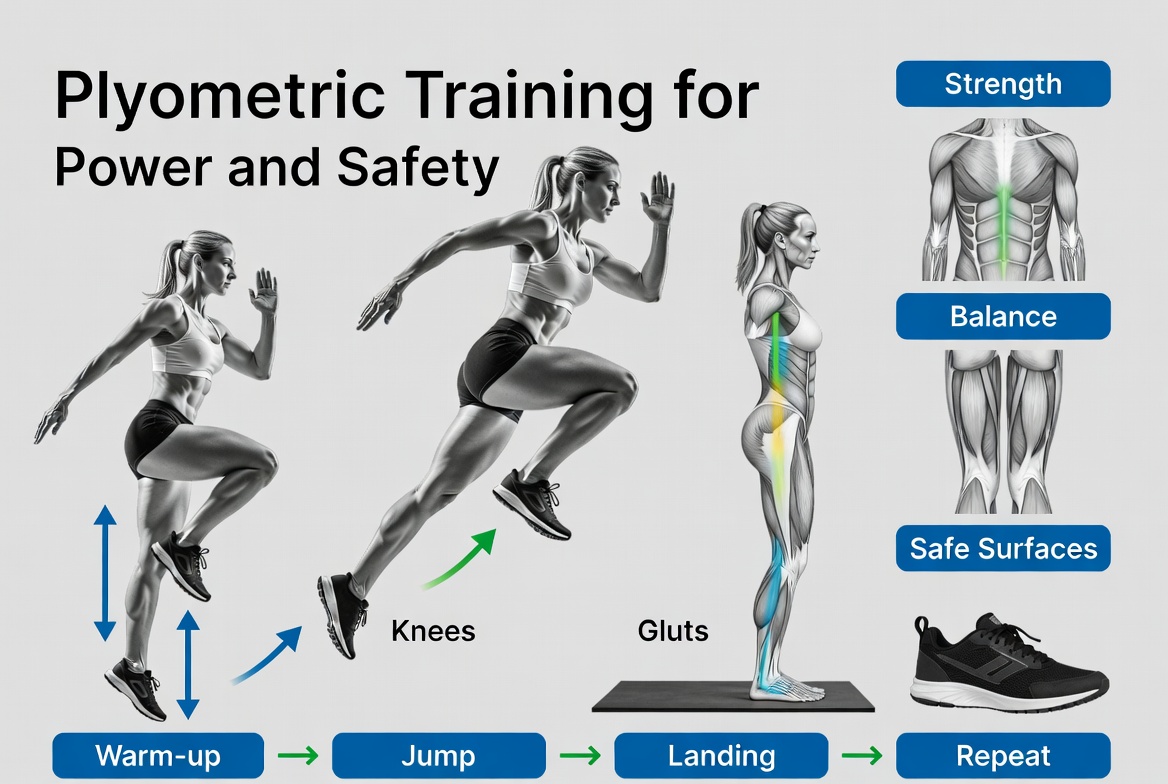
Plyometrics refers to the fast and powerful movements training. Most refer to it as jump training since it normally involves activities such as jumping, hopping or bounding. The goal is simple. You work your muscles to develop speedy forces. It occurs in what is known as stretch-shortening cycle. It is how the muscles store and release energy in the natural manner in which you move. Due to this reason, plyometrics would enable you to be more explosive, quicker, and reactive.
This form of training is common in most sports. It is used by athletes to enhance jump height, sprint speed and agility. The thing is that you do not have to be an athlete to be able to gain the benefit. Properly applied, plyometrics may enhance the normal strength and balance. It trains your body to move in a more controlling and balanced manner. This would make you more stable and confident about what you do each day.
Plyometrics may be very effective, and yet it requires the approach. It is important that the technique is proper, the progressions are safe, and the landing form is good. These measures save your joints and make you achieve some real results. Here, you will be taught what plyometrics is, how it functions and how you can use this safely. This is aimed at providing you with clear and useful information that you can trust and understand.
The Plyometrics mechanism How it works: the science of explosive power.
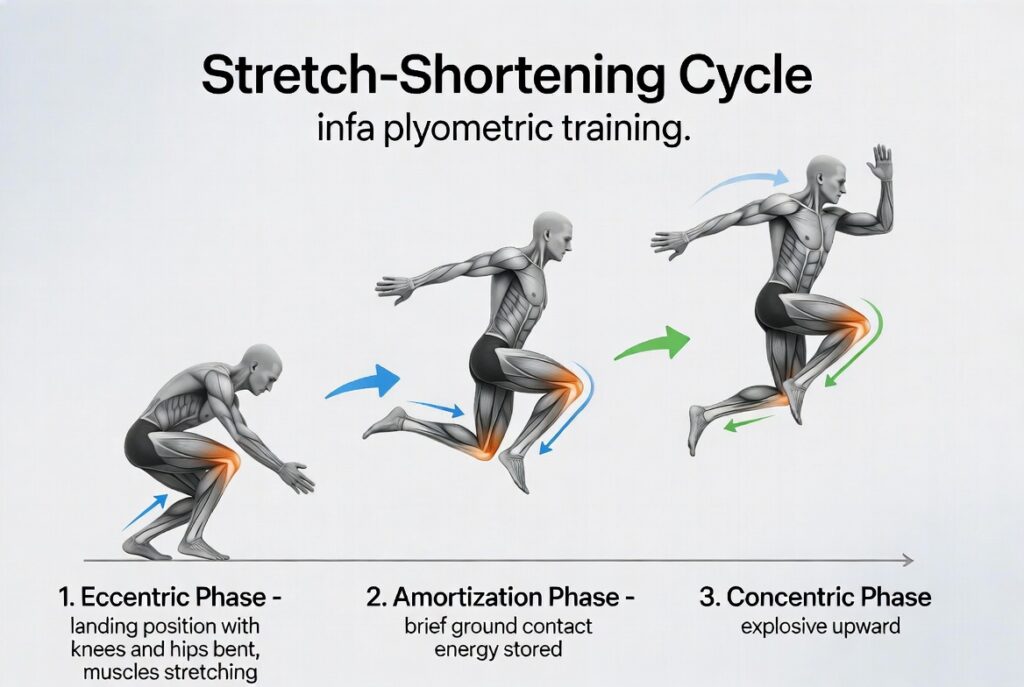
Plyometrics occurs in one of the natural processes in your muscles known as the stretch-shortening cycle. This cycle follows three steps, including an eccentric phase, a brief rest period known as the amortization phase, and a concentric one. In simple terms, your muscles initially get stretched and then alternate and ultimately, contract. This rapid transformation assists your body to generate more speed and power. It is what makes the movements such as jumps, bounds and hops explode.
The eccentric stage is whereby the muscles are loaded with force during landing or lowering of the body. During the amortization stage this energy is stored in your body for a fraction of a second. This is followed by the concentric phase which is where you push off the ground or launch into the succeeding movement. The quicker you pass the phases the more power you generate. That is why coaches and sport agencies such as NSCA pay much attention to landing mechanics, rapid transitions, and appropriate body control.
Plyometric exercise also enhances your reactive and force development rate. These words refer to the speed at which you can respond and exert force by muscles. The nervous system is made more effective when you repeat plyometric exercises. This will assist you in leaping higher, moving quicker and maneuvering directionally a lot easier. It also enhances improved balance and coordination which comes in handy in both sporting and life in general.
The knowledge of this science helps to realize why plyometrics is so useful. It is not just that you are developing powerful muscles, you are also training your body and brain to work in unison at a high rate. I never doubt myself because I know I can do it as sprinter Usain Bolt once put it. This attitude is an expression of the reliability and concentration required to make explosive moves safely and efficiently. There is a combination of proper technique, safe progressions, and controlled movements, which will result in the maximum benefit of an entire stretch-shortening cycle. It preconditions all plyometric exercises you will get to know in the following sections.
Benefits of Plyometric Training
Plyometric training has numerous advantages to athletes, amateurs, and any other person who wishes to move better. The enhancement of explosive power is one of the primary benefits. This implies that you will be able to run higher, run quicker and respond faster. Since plyometrics is a stretcher training, your muscles will learn to generate force within a short period. It could be applied to sports, such as basketball, football, volleyball, and track, in which fast movements are important. It also assists in the enhancement of your responsiveness or strength which assists in speed, agility, and general athletic ability.
The other major advantage is enhancement of coordination and body control. Plyometric training teaches the body to absorb force, land on soft surfaces and create balance. These muscles can make the difference in the effects on your joints and help avoid injuries. This is the reason why landing mechanics are emphasized by such organizations as NSCA, HSS, and strength coaches as an essential element of training. A good jumping and landing will result in stronger legs, more stable hips, and improved movement patterns.
Functional fitness can also be enhanced with plyometrics, i.e. moving with more confidence in everyday life. Even activities that are simple such as climbing stairs, catching yourself when you slip or picking something off the ground are simplified. There are even studies that indicate safe, low-impact plyometrics may aid in the strength of bones and may assist the older people in staying mobile. These benefits do not require high skills. The beginners can initiate with low intensity movements and gradually escalate with the right progressions and technique.
In general, plyometric training is a hybrid training method of strength, speed, balance and coordination that can be used in one exercise. It assists your body to move more smoothly and more actively. When practiced in a safe manner, it can be a great resource in health, as well as performance.
Who Newtons and Nontonians Plyometrics.
Plyometrics can be beneficial to many individuals but one should understand whether he/ she is fit to undergo this kind of training. Plyometric exercises are performed with quick and explosive motions, so you will have to have a minimum of strength and equilibrium to begin with. Simple exercises such as bodyweight squats, lunges and step-ups should be performed in a good form. This base assists your joints to absorb the force of jumping and landing. The NSCA and guides employed at hospitals including HSS emphasize the necessity of correct landing technique and controlled motion prior to increase in intensity.
Plyometrics is a good option among athletes that need to enhance the height of the jump, sprint speed, or agility. It is also suitable amongst the active people who desire to move with more power and coordination. Novices can also perform plyometrics, however, with low-impact options like small hops, step jumps or soft bounds. These alternatives exercise the stretch shortening cycle but with less strain on knees and ankles. However, as your technique advances with time you are able to progress to more difficult movements.
Nevertheless, plyometrics might not be appropriate to all people. Individuals suffering injuries or experiencing pains on the joints must not engage in high-impact jumps until the doctor or physical therapist declares it to be safe. Balance or stability conditions are also conditions that may necessitate additional care. In case you experience sharp pain during the jumping or landing, then you should pause and re-evaluate your position or seek a less vigorous activity. The aim is to train safely, guard your body and develop confidence slowly by slowly.
When you know who to do the plyometrics, you will train smarter. Being guided by the correct progression and listening to your body, plyometrics is a safe and efficient method of gaining strength and power.
| Section | Key Points |
|---|---|
| Plyometrics Kya Hai | Fast & explosive movements training; jump, hop, bound exercises |
| Main Goal | Power, speed, reactivity aur coordination improve karna |
| Scientific Basis | Stretch-Shortening Cycle (Eccentric → Amortization → Concentric) |
| Kaam Kaisay Karti Hai | Muscle energy store + release karta hai for explosive force |
| Primary Benefits | Jump height ↑, sprint speed ↑, agility ↑, balance ↑ |
| Functional Benefits | Daily movements easy, stability better, confidence increase |
| Sports Use | Basketball, football, volleyball, sprinting, athletics |
| Beginners Ke Liye | Low-impact jumps, proper technique, gradual progression |
| Athletes Ke Liye | High-intensity jumps, reactive power, sport-specific drills |
| Kaun Kar Sakta Hai | Athletes, active adults, beginners (safe progression ke sath) |
| Kaun Avoid Kare | Joint pain, recent injury, balance issues (doctor approval zaroori) |
| Safety Focus | Soft landings, knee-to-toe alignment, controlled movement |
| Warm-Up Zaroori | Light cardio + dynamic stretching + movement prep |
| Training Frequency | 2–3 sessions per week |
| Recovery Time | 48–72 hours same muscle groups ke liye |
| Progression Model | Control → Landing → Strength → Reactive Power |
| Beginner Exercises | Mini hops, squat jumps, step-ups |
| Intermediate Exercises | Box jumps, depth jumps, single-leg hops |
| Advanced Exercises | Lateral bounds, reactive jumps, explosive throws |
| Upper Body Plyometrics | Clap push-ups, medicine ball throws |
| Common Mistakes | Hard landing, overtraining, poor technique |
| Pain vs Soreness | Muscle soreness normal, joint pain = stop |
| Strength Training Combo | Plyometrics + weights (proper planning ke sath) |
| Long-Term Results | Better power, coordination, injury risk kam |
| Final Advice | Start slow, focus on form, progress gradually |
Warm-Up Checklist and Safety Rules.
Safety is the most important element of a plyometric exercise program. As plyometrics is a series of fast and explosive motions, you have to be fit before you start. Through adequate warming-up, your muscles, joints and nervous system are ready to respond in a fast manner. It also reduces the risk of being injured. An appropriate warm up should include light cardio, stretching exercises and body movement movements exercises. This heats up the stretch shortening cycle and makes your body think in control.
Get ready to train by warming up with some light activities like jogging or bicycling (five to ten minutes). Next add some dynamic moves such as leg swings, high knees, butt kicks and hip circles. These help in improving the flow as well as in soothing your muscles. Conclude with movement preparation exercises like body weight squats, glute bridges and mobility exercises on the ankle. These exercises improve landing skills and develop the muscles that you perform in making jumps and hopping.
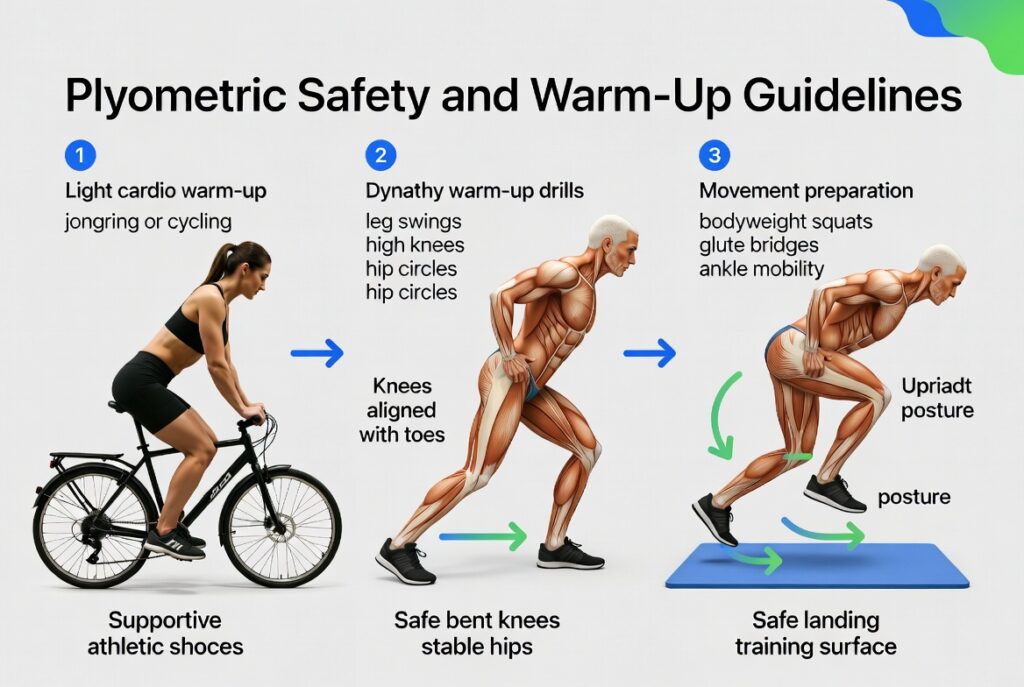
These are also among the safety guidelines to observe before any plyometric session besides warming up. Choose a surface that is either too hard or too soft. Wear supportive shoes and this will absorb the impact during landing. Jump straight with your toes knees up. Squat with ankles and knees at the same time. This is padding your joints and getting you stronger in the next movement. Take a break between the sets; do it to avoid muscle fatigability in your body. The normal time taken for most individuals to recover before the next plyometric exercise is forty eight to seventy two hours.
An example of a warm-up checklist is provided below:
• Have five to ten minutes of light-cardio.
• Include some vigorous stretching of your hips, legs and ankles.
• Teach yourself on how to perform simple exercises like squats and lunges properly.
• Check the training surface and shoes are safe.
Start with low intensity leaps and then move on to vigorous exercises.
These activities will help you to maximize your training. It keeps your body stable and secure too, to cause strong movements and have no fear.
Progression Model: The Plyometric Program Building.
Properly planned plyometric exercises are a good way to become stronger, more powerful, and agile. The reason why progression is important is that also jumping exercises are very stressful to muscles and joints. According to NSCA and HSS specialists, it is better to begin with simple and low-intensity exercises and progress to more complicated and intense activities. This makes your body fit well and it minimizes the chances of being hurt.
The majority of plyometrics programs have four stages:
Movement and Co-ordination Phase.
Start with simple exercises which train your body on proper movement. Concentrate on low impact jumps, mini-jumps and step-ups. Balance, posture and soft landings, pay attention. The aim at this point is to grow domination as opposed to authority.
Landing and Absorption Phase.
After learning the simplest movements, incorporate exercises which will test your capacity to receive force. Squat jumps, little bounds and controlled landings of drops will aid in strengthening knees, hips and ankles. The practice of landing correctly is important in this situation, because this preserves the joints, and also gets your muscles ready in case of more explosive movements.
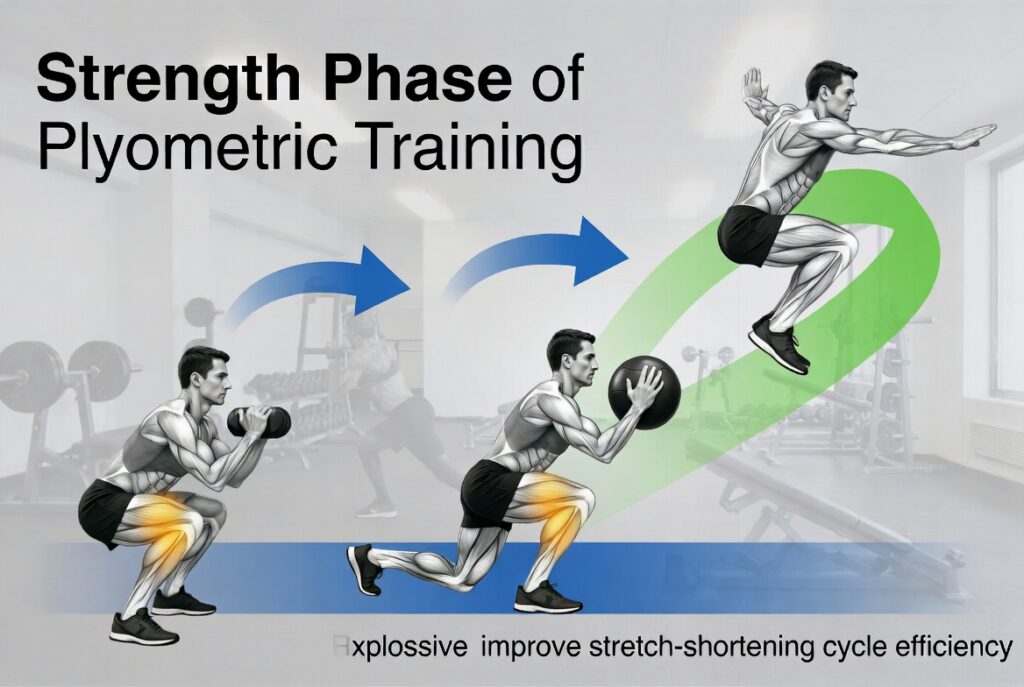
Strength Phase
Include workouts that enhance muscle power and stamina. This can take the form of weighted squats, lunges or medicine-ball exercises and combined with jumps. Development of strength at this stage makes stretch shortening cycle more efficient and the high-intensity plyometrics ready.
Reactive Power Phase
The last stage is concerned with speed and explosiveness. Depth jumps, box jumps, bounds and lateral jumps make your muscles learn how to generate force within a short period. Your landing technique should be perfected at this point and your body should be fit enough to withstand the impact without any harm.
The average program would be 6-8 weeks, each week two or three plyometric sessions, depending on your level of experience and objectives. Novices ought to begin with low intensity training and progressively build on quantity and sophistication. The middle and advanced athletes are able to engage in movements of high intensity, which involve sport-specific movements.
Strict adherence to a progression model is a sure way of getting your body to adjust safely. It makes you gain strength, perform better, as well as minimizes the risk of injury. To make this process more practical and to follow it, we will examine the best plyometrics exercises with cues, regressions and progressions in the following section.
Read Also: Sporple: Athlete Networking & Recruitment Platform
Best Plyometric exercises (Cue and Regressions)
Plyometric exercises are related to speed, power, and coordination. The correct selection of the exercises and their proper execution are the main factors of safe and efficient training. These are the best plyometric movements with technique cues, regressions, and progressions, divided into categories applying to each type.
1. Low-Impact Starters
- Mini Hops: Stand on both feet, and make little jumps up.
- Cue: Walk on the balls of your feet and maintain knees slightly bent.
- Regression: Heel raise or step-ups in place of hopping.
- Progression: Communicate lateral mini hops or small bounds.
- Squat Jumps: A squat in bodyweight with an explosion of upwards jumping.
- Cue: Maintain upright posture, land with soft landing, fold knees upon landing.
- Regression: Half squat jumps/ sit-to-stand jumps.
- Progression: Have a squat before jumping or have light dumbbells.
2. Bilateral Jumps
- Box Jumps: Jump to a stable box or platform and use both feet.
- Clue: Use swinging arms to gain the momentum, land softly on the knees, and step down safely.
- Regression: Reduce box height or make step-ups.
- Progression: Add a box jump or increase box height.
- Depth Jumps: Get off of a box and jump right after landing.
- Action: Take impact with knees and hips and jump off.
- Regression: First lower box height or practice landing mechanics.
- Transition: includes a sideways leap on landing.
3. Single-Leg Progressions
- Single-Leg Hops: Forward or stationary jumping on one leg.
- Cue: Keep the balance, land and keep the knee straight.
- Regression: Have something to hold on to.
- Advancement: Add a distance or a lateral hop.
- Lateral Bounds: Lateral jumping on one leg.
- Stimulus: Land, absorb and push off at once.
- Regression: Decrease the distance of leaping or walk on two legs.
- Development: Add speed or add a forward hop.
4. Upper-Body Plyometrics
- Clap Push-Ups: Take off the ground with a great impulse and make a clap in the middle of the air.
- Instructional Cue: Roll tight and fall on your hands.
- Regression: Do a small lift off-ground push-up.
- Progression: Use medicine balls throws or explosive incline push-ups.
- Medicine Ball Throws: Throw a medicine ball forwards or against a wall.
- Signal: Hips and arms together, explode.
- Regression: Smaller or lighter ball throws.
- Progression: Add jump squats or gain weight.
Through these exercises, you get better at reactive strength, speed in development of force and your athletic performance. Beginning with low impact exercises is safe whereas progressions can make your body get challenged step by step. We will present sample workouts to include these exercises as one workout that consists of beginner, intermediate and advanced workout to accomplish the best possible results in the following section.
Sample Workouts
Structured plyometric exercise makes you exercise safely and achieve optimal outcomes. Exercises must correspond to your level of experience and have a succession model. Three of the routines are beginner, intermediate, and low-impact training sample routines. They are sets, reps, rest, and tips on how to do it correctly.
1. Plyometric Workout (2×/week) is basic.
Mini Hops – 3 sets of 10 reps
Squat Jumps – 3 sets of 8 reps
Step-Ups (on to a low platform) -3 sets of 10 reps each leg.
Lateral Bounds (short distance) 2 sets of 6 on each side.
Rest: 60–90 seconds between sets
Hint: Pay attention to soft landings and alignment of knees.
2. Intermediate/ Athlete Plyometric Workout (23 times/week)
Box Jumps – 3 sets of 8–10 reps
Depth Jumps – 3 sets of 6–8 reps
Single-Leg Hops- 3 sets of 6-8 reps each leg.
Medicine Ball Chest Throws -10 repetitions in 3 sets.
Rest: 90–120 seconds between sets
Hint: Explosive movements should be employed, and control in landings should be maintained.
3. Plyometric Low Impact / Senior Workout (2×/week)
- Mini Hops – 2 sets of 8–10 reps
- Sit-to-Stand Jumps (without jump in case of necessity) 2 sets of 10 reps.
- Step-Ups – 2 sets of 8–10 reps per leg
- Lateral Bounds (two legs, short distance) 2 sets of 6-8 reps on each side
- Rest: 90 seconds between sets
- Note: Concentrate on balance, slow motion and easy range of movement.
- The general principles of every workout include:
- Warm-up Warm-up 10 to 15 minutes then get into light cardio and some dynamic stretches.
- Always make soft landings and align to conserve your joints.
- Reduce sets in the case of fatigue or start with a lower intensity.
- Provide a rest period between plyometric sessions in the same muscle group of 48-72 hours.
These sample exercises enable an easy use of plyometric training in a safe way. Through the right progression and adherence to rest intervals, you will be able to build power, agility and coordination over time, thereby decreasing the chances of injury.
Frequently Asked Questions:
The frequency, technique, and progress are some of the questions that arise when beginning plyometric training. By dealing with these issues, you are able to train safely and effectively.
What is the frequency of plyometrics training?
The majority of the population can get away with 2-3 sessions per week. Two sessions should be the first step and attention should be on the correct form. An athlete can train as much as three times per week but he/she should always have a 48-72 hours rest between sessions involving the same sets of muscles. Excessive training has the potential to augment the danger of harm and decrease the performance gains.
Will I know when I am landing right?
The important thing about plyometrics is proper landing. Knees to toes should be at the same level and hips and knees should bend to receive impact. Gently drop on the undersoles of your feet, and never lock up your knees. Basic jumps with the use of mirrors or video feedback can be practiced to enhance technique.
What is the distinction between soreness and pain?
Light muscle pains are normal particularly when one begins to do new exercises. Pain or sharpness of joints is an alarm. In case you feel pain in your knees or ankles or hips, then halt the exercise and re-examine your posture. Discontinue but think of using less harmful variations or go to a professional.
Is it possible to have plyometrics and strength training?
Yes. The plyometrics are combined with weight training by many sportspeople to gain strength and power. One of the popular methods is to have the plyometric sessions on other days other than the heavy strength workouts or you can also do the plyometric sessions prior to lifting when your muscles are still fresh. This maximizes explosive performance and minimizes the risks that are caused by fatigue.
How do I progress safely?
Begin with low impact exercises with low intensity. Practice on technique and mastery and build up height, range, and difficulty. Add sets, reps and more difficult movements gradually with the strength and coordination you gain. Training with a progression model makes your body adapt to the training without overworking muscles and joints.
These are the most frequent questions that can be answered and help you to prevent errors and to get the highest return out of plyometrics. The important thing to remember is that safe and effective training of both beginners and professional athletes should be performed following proper technique, rest, and progressive development.
Conclusions:
Explosive strength, speed, and coordination can be gained with the help of plyometric training. It is effective through the stretch shortening cycle, a process that assists your muscles in storing and releasing energy in a very rapid manner. This is a training process that enhances the jump height, sprints, agility and even functional fitness in performing daily movements.
It is necessary to be safe and work in the proper technique. The correct warm-up should always begin, soft landings should be emphasized, and simple exercises with low impact should be performed first, followed by more complicated exercises. In a well organized program and sufficient rest and recovery prevents injury and maximizes the results.
The following are some of the steps that can be taken:
- Start with simple exercises such as mini hops, squat jumps and step-ups.
- Increase in intensity should be preceded by working on landing and body control.
- Train between 2 and 3 times a week with 48 to 72 hours rest between training.
- Once you get stronger and have better coordination add harder exercises and volume gradually.
- Get yourself motivated by measuring your progress through jump height, balance or agility tests.
With the help of this advice, you can safely integrate plyometric training into your training habit. Is it the performance benefits that you are seeking as an athlete or do you just need to move better in your daily life? Plyometrics provides quantifiable benefits which increase with time.
